
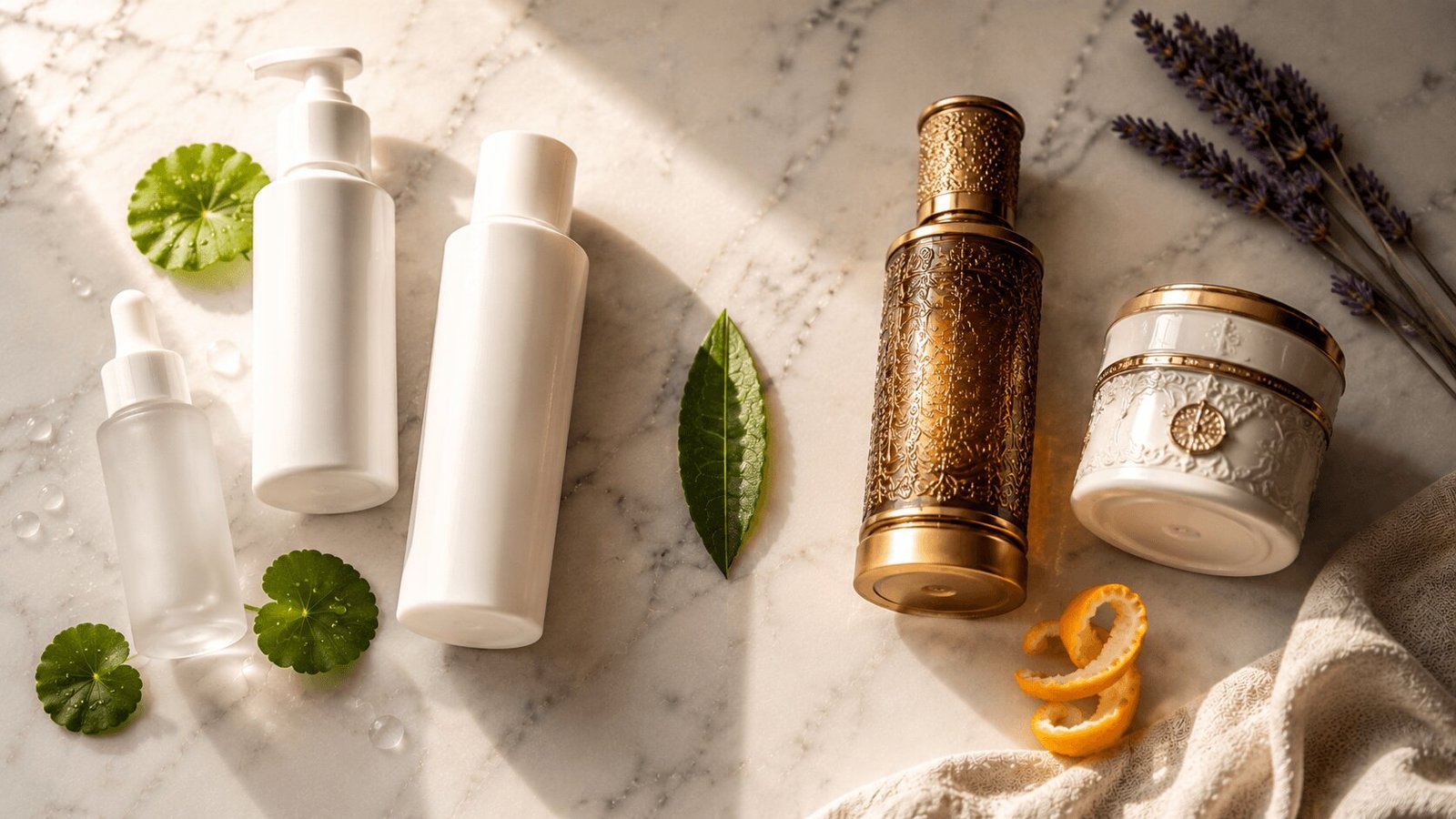
The product that broke me out was labeled as natural.
The front of the packaging said something about botanical extracts and gentle formulation. The back had an ingredient list with seventeen entries, three of which were essential oils — lavender, bergamot, and eucalyptus. I read “natural” on the front and assumed safe. I did not read the back at all.
Within four days I had the most concentrated breakout I’d experienced in years along my cheeks, which is not even an area I typically break out. It took me another week of detective work — removing one product at a time — to identify the culprit. A product I’d bought specifically because it said natural on the packaging was what caused it.
That experience fundamentally changed how I shop for Korean skincare. I stopped reading front-of-packaging claims and started reading actual ingredient lists. And once I started reading ingredient lists properly, I realized how many products I’d been confidently using contained things that were quietly working against me.
This guide is what I wish I’d had before that breakout.
A Quick Reality Check Before the List
Before getting into specific ingredients, two things are worth establishing because they save a lot of confusion.
“Natural” does not mean safe. This is the most important thing to understand about cosmetic ingredients. Poison ivy is natural. Arsenic is natural. Lavender essential oil — also natural — is one of the most common causes of cosmetic contact dermatitis. The naturalness of an ingredient has essentially no bearing on whether it’s appropriate for your skin. What matters is the specific ingredient, the concentration, and how your particular skin responds to it.
Context determines everything. The smartest way to approach ingredient red flags is to stop asking “Is this good or bad?” and start asking “Is this right for my skin right now?” A retinol cream that transforms one person’s texture can leave another’s skin raw and reactive. A fragrant botanical essence can feel luxurious on resilient skin and become a fast track to irritation on a compromised barrier.
With that framework established — here are the ingredients worth understanding before you buy.
Ingredients to Avoid or Watch Closely
Denatured Alcohol — Alcohol Denat, Ethanol, SD Alcohol
This is the ingredient I tell people to look for first because it appears so frequently in products that feel elegant on application and cause chronic damage over time.
Denatured alcohol in skincare creates an immediate mattifying or cooling sensation that feels like effectiveness. The formula dries fast and feels fresh. What’s actually happening is that the alcohol is dissolving the lipid layer of your skin barrier with every application — the same way it dissolves grease, which is why it works as a disinfectant.
In some formulas, alcohol helps products absorb quickly and feel fresh rather than greasy. The trade-off is that it can be drying or irritating for people with dehydrated skin, a weak moisture barrier, or sensitivity from actives. If your skin feels tight after application or gets shiny and flaky at the same time, this is a category to watch.
What makes this particularly problematic is the cumulative effect. One product with alcohol once a week probably doesn’t cause visible damage. A toner, an essence, and a serum all containing alcohol used twice daily for months creates chronic barrier disruption that shows up as perpetual slight irritation, increased oil production, and the dehydrated-yet-oily situation that I covered in my guide on how to fix a damaged skin barrier.
How to spot it on labels: Alcohol Denat, Ethanol, SD Alcohol, Isopropyl Alcohol. Note that fatty alcohols — Cetyl Alcohol, Stearyl Alcohol, Cetearyl Alcohol — are completely different and actually beneficial for skin. Only the first category above causes problems.
Dry skin is particularly vulnerable to these barrier disrupting ingredients — my guide on Korean skincare for dry skin covers what to use instead for deep hydration without the stripping effect.
Synthetic Fragrance — Parfum, Fragrance
Fragrance is one of the most common triggers for sensitive or reactive skin. This includes added parfum as well as fragrant essential oils like lavender, citrus, peppermint, bergamot, and eucalyptus. In some Korean skincare formulas, these ingredients are used to elevate the sensorial experience. That can be appealing, but skin that is already inflamed may not agree.
Fragrance is the number one cause of contact dermatitis in cosmetics globally. It appears on ingredient lists as “Parfum” or “Fragrance” — collective terms that can encompass dozens of individual chemical compounds without specifying which. This opacity makes identifying the specific trigger difficult when a reaction occurs.
Artificial fragrances can cause your skin to feel itchy and lead to allergic reactions. A good beauty routine should not cause these problems.
The challenge with fragrance specifically in K-beauty is that many Korean products contain it because it contributes to what brands call the “sensorial experience” — the pleasant smell that makes a routine feel luxurious. For skin that tolerates it well this is mostly aesthetic. For reactive, sensitive, or barrier-compromised skin it’s a real problem.
This is something I noted honestly in my Laneige skincare review — several Laneige products contain fragrance which makes them worth patch testing carefully for sensitive or reactive skin types.
The honest assessment: if your skin is currently healthy and non-reactive, low fragrance levels in a product probably won’t cause you issues. If your skin is sensitive, reactive, or recovering from barrier damage — fragrance-free is not a preference, it’s a requirement. I covered this extensively in my guide on Korean skincare for sensitive skin.
Sodium Lauryl Sulfate — SLS
Sulfates make more bubbles and foam, but they also take away the skin’s natural oils. There are reports where people had problems after using Korean beauty products with harsh chemicals like sulfates, including skin irritation, dryness, allergic reactions, and contact dermatitis.
SLS appears in cleansers and produces the satisfying lather most people associate with clean skin. The problem is that it achieves that lather through a surfactant action that is too harsh for facial skin — it removes not just impurities but the natural lipids that make up your barrier’s structure.
This is precisely why Korean skincare emphasizes low pH, gentle cleansers over foaming alternatives — a point I cover in detail in my guide on the best Korean cleansers on Amazon. The best Korean cleansers achieve thorough cleaning through pH-appropriate surfactants and formulation rather than through the aggressive action of SLS.
Better alternatives: Sodium Cocoyl Isethionate, Cocamidopropyl Betaine, Sodium Lauroyl Glutamate — all effective at cleansing without the stripping side effects.
Parabens — Methylparaben, Propylparaben, Butylparaben
Parabens help skincare products last longer. Some research shows they may change the way hormones work. The K-beauty movement toward paraben-free formulations has prompted most Korean brands to reformulate.
The science on parabens is genuinely more nuanced than clean beauty marketing suggests — the concentrations used in cosmetics are very low and regulatory bodies in both the EU and Korea have established acceptable use limits rather than outright banning them. However, the concern about endocrine disruption at cumulative exposure levels is real enough that most Korean brands have moved away from them as a precautionary measure.
For combination skin specifically understanding which ingredients affect the T-zone differently from cheeks is important — my guide on Korean skincare for combination skin covers zone-specific ingredient choices.
COSRX is one of the clearest examples of a Korean brand that consistently avoids these problematic ingredients while maintaining effective formulas — I cover their full range in my COSRX skincare review.
The term “clean” in cosmetics refers to products formulated without potentially harmful ingredients, such as parabens, sulfates, phthalates, polyacrylamide, PEG compounds, mineral oils, and synthetic fragrances.
Most modern Korean skincare products use alternative preservative systems — phenoxyethanol, ethylhexylglycerin — that maintain product safety without the hormonal concern. Choosing paraben-free Korean products is straightforward because most current formulations already are.
Essential Oils — Lavender, Citrus, Eucalyptus, Peppermint, Bergamot
This was the ingredient category responsible for my opening story breakout, and it’s one that catches people most off-guard because these ingredients are universally perceived as gentle and beneficial.
Essential oils such as eucalyptus, rosemary, and tea tree may increase irritation risk for sensitive skin. They are not ideal for reactive or rosacea-prone skin.
The issue with essential oils in skincare isn’t that they’re inherently dangerous — it’s that they’re complex mixtures of active compounds, many of which are known sensitizers. Lavender contains linalool and linalool acetate, both fragrance allergens. Citrus oils contain limonene and citral, also common sensitizers. These compounds appear on ingredient lists individually when they’re used in fragrance formulations — which is how you can technically avoid them even in products that don’t say “essential oil” on the label.
For resilient skin with no history of sensitivity, occasional essential oil exposure in well-formulated products probably doesn’t cause lasting problems. For anyone with sensitive, reactive, rosacea-prone, or acne-prone skin — essential oils are genuinely worth avoiding. The ingredient that causes chronic mild irritation you can’t quite identify is often an essential oil listed at the end of an ingredient list.
Comedogenic Oils — Coconut Oil, Wheat Germ Oil, Flaxseed Oil
Not all oils are comedogenic, and this myth gets overextended to the point where people avoid all facial oils unnecessarily. The specific oils that cause problems are those with high levels of fatty acids known to trigger comedone formation in pore-prone skin.
Coconut oil is the most commonly encountered problematic oil in skincare — it rates highly on comedogenic scales and consistently causes closed comedones on pore-prone skin despite its popularity in wellness contexts. Wheat germ oil and flaxseed oil have similar profiles.
For acne-prone skin specifically — which I covered thoroughly in my guide on Korean skincare for acne prone skin — any product containing coconut oil as a primary ingredient is worth patch testing carefully before full-face application. The closed comedones it triggers can take weeks to surface, making the connection to the offending product difficult to identify.
Non-comedogenic alternatives: Squalane, rosehip oil, marula oil — all with low comedogenic ratings and excellent skin compatibility for most acne-prone skin types.
Physical Exfoliant Scrubs with Rough Particles
<cite index=”9-1″>Scrubs with rough particles, crushed shells, or aggressive polishing beads can create micro-irritation, especially if you are already using acids, retinol, or other active treatments. Smooth skin should feel refined, not raw. If a product leaves your face hot, shiny, and overly tight, that clean feeling is often a warning sign.</cite>
Korean skincare has largely moved away from physical scrubs toward chemical exfoliation — AHA, BHA, and PHA acids that work without the mechanical friction that creates micro-tears in skin. For most skin types, chemical exfoliation is safer and more effective than physical scrubbing.
The exception is very gentle enzyme-based exfoliants and soft wash-off products that don’t require rubbing pressure. These sit in a different category from abrasive walnut shell or sugar scrub style exfoliants that cause visible redness with regular use.
Over-Acid Stacking — Too Many Actives at Once
Problems start when you stack too many acid-based steps, use them too frequently, or combine them with retinol without enough recovery time. For oily, congested skin, exfoliating acids can refine pores and smooth texture. But overdoing acids is one of the fastest ways to sabotage your glow.
This isn’t a single ingredient to avoid — it’s a formulation practice worth understanding. Using an AHA toner, a BHA serum, a retinol, and a vitamin C in the same routine without appropriate spacing creates compounding irritation that damages the barrier faster than any individual active ingredient.
The signs of over-acid stacking: persistent subtle redness that doesn’t resolve, skin that feels tight and then oily, increased sensitivity to things that previously didn’t bother you, a dry flaky texture that moisturizer doesn’t fix.
The fix is the same one I always recommend — introduce one active at a time, give your skin two to three weeks to adjust before adding another, and always have at least one to two active-free evenings per week for recovery.
The HwaHae App — How Koreans Check Ingredients
HwaHae is the number one Korean beauty app where you can check the ingredients in your skincare or cosmetic products. More than 260,000 products and 14,000 brands are registered in their database. More than 50% of Korean females in their twenties and thirties use their services.
The app allows you to scan or search a product and see a breakdown of its ingredients, flagging those on the Korean “20 ingredients to avoid” list and rating their irritation and comedogenic potential. For anyone who wants to research products more thoroughly before buying — this is the most comprehensive tool available and it’s free.
The Western equivalent tool is CosDNA — a database that scores ingredients on irritation and comedogenic potential on a numerical scale. Neither is infallible, but both are significantly more useful than reading “natural” on a front label and assuming safety.
Common Myths Worth Correcting
“Silicones are harmful to skin.” Silicones — dimethicone, cyclopentasiloxane — coat the skin surface and create a smooth texture. They don’t penetrate deeply, don’t disrupt hormones, and don’t “suffocate” pores. The concern about silicones trapping debris is theoretically plausible but not well-supported in practical use for most skin types. Silicones are genuinely problematic for a small subset of people who notice milia formation — but for most users they’re inert and safe.
“Mineral oil clogs pores and causes breakouts.” Mineral oil used in cosmetics is highly refined and non-comedogenic at the grades used in skincare. The “mineral oil clogs pores” myth originates from industrial-grade mineral oil not used in cosmetics. Refined cosmetic-grade mineral oil is one of the most well-studied moisturizing ingredients available.
“Preservatives are always harmful.” Preservatives prevent bacterial and fungal contamination that would otherwise make products unsafe to use within days of opening. A preservative-free product isn’t safer — it’s either less stable, shorter shelf life, or requires refrigeration and careful handling. The question isn’t whether a product is preserved but whether the specific preservative used is appropriate for your skin.
“Fragrance-free means unscented.” Products labeled “unscented” may contain masking fragrances — fragrance added to neutralize other ingredient smells — which still cause the same reactions as regular fragrance. “Fragrance-free” on a label is the meaningful claim. “Unscented” is not.
How to Read a Korean Ingredient List
INCI names — International Nomenclature of Cosmetic Ingredients — are standardized across all products regardless of country of origin. A Korean product and an American product will list the same ingredient the same way.
Order matters. Ingredients are listed in descending order of concentration. The first five ingredients typically make up 80 to 95% of the product. An ingredient listed at the very end of a long list — especially after preservatives — is present at under 1% concentration and unlikely to have significant effect positive or negative.
The five-ingredient check. Before buying any skincare product, check the first five ingredients. If those five are solid — water-based, appropriate pH-compatible ingredients, no immediate red flags — the product is likely worth trying even if there are minor concerns further down the list.
Watch for fragrance position. Fragrance appearing early in an ingredient list signals a high concentration. Fragrance listed last after preservatives means a minimal amount present primarily for masking purposes — a much lower risk level.
Sheet masks are one product category where fragrance position matters particularly — my guide on the best Korean sheet masks on Amazon covers options specifically formulated without common irritants for sensitive skin.
My Korean skincare ingredients explained guide covers the positive side of this — understanding what to look for. Together these two articles give you the full picture of reading labels intelligently.
Ingredient Pairings to Avoid
Retinol and AHA or BHA on the same evening. Both increase cell turnover simultaneously and create compounding irritation. I covered this in my Korean skincare night routine guide — alternate nights rather than combining.
For the correct way to introduce retinol into a Korean anti-aging routine without these combination mistakes my Korean anti-aging skincare guide covers the full protocol including timing and frequency.
Vitamin C and retinol together. Can be layered by experienced users but for beginners and sensitive skin — morning vitamin C, evening retinol.
Benzoyl peroxide and retinol. Benzoyl peroxide oxidizes retinol, rendering it ineffective. Keep these on separate evenings if using both.
Physical scrub on the same day as acid exfoliation. Double mechanical and chemical exfoliation on the same day creates excessive barrier disruption. Choose one or the other per session, never both. For men specifically post-shave physical scrubbing compounds this damage significantly — my guide on Korean skincare for men covers exactly what to use and avoid specifically for shaving skin.
Multiple fragrance-heavy products layered together. A fragrant toner followed by a fragrant essence followed by a fragrant cream multiplies fragrance exposure significantly. Individual products at low fragrance levels become a meaningful cumulative dose layered together.
For the complete morning routine structure including where vitamin C fits correctly my Korean skincare morning routine guide covers the full step-by-step order.
This ingredient philosophy is one of the core reasons Korean skincare consistently outperforms Western approaches for sensitive skin — I cover the full comparison in my guide on Korean skincare vs Western skincare.
FAQs About Korean Skincare Ingredients to Avoid
Is Korean skincare generally safer than Western skincare on ingredients?
Korean products undergo rigorous testing before reaching consumers. The Korean Ministry of Food and Drug Safety maintains strict standards comparable to FDA regulations. Korean skincare isn’t inherently safer or more dangerous than Western skincare — the quality varies within both categories. Ingredient awareness matters regardless of origin.
Are all alcohols in skincare bad?
No — fatty alcohols (Cetyl Alcohol, Cetearyl Alcohol, Stearyl Alcohol) are emollients that improve texture and are beneficial for skin. Only denatured or simple alcohols (Alcohol Denat, Ethanol, Isopropyl Alcohol) are the ones to watch for.
Should I avoid all products with essential oils?
If you have sensitive, reactive, or acne-prone skin — yes, avoiding essential oils makes sense as a precautionary approach. If your skin is resilient and non-reactive, low levels of essential oils in well-formulated products probably won’t cause you issues. Patch test and monitor.
How do I know if an ingredient is causing a reaction?
The elimination method — removing one product at a time for three to four days and monitoring whether the reaction improves — is the most reliable approach. This is why introducing new products one at a time matters so much for identifying specific ingredient sensitivities.
Is phenoxyethanol safe as a preservative?
Phenoxyethanol is the most common preservative in modern Korean skincare replacing parabens. At concentrations used in cosmetics (generally under 1%) it’s considered safe by EU and Korean regulatory authorities. Some people with contact dermatitis sensitivity may react to it, but it’s generally well-tolerated.
Reading Labels Going Forward
The product that broke me out was the most useful skincare lesson I’ve had — not because of the breakout itself but because of what came after it. I stopped trusting front-of-packaging marketing and started trusting ingredient lists instead.
That shift takes a few minutes of learning but changes how confidently you can shop forever. Knowing that alcohol denat strips your barrier, that fragrance is the most common sensitizer, that fatty alcohols are beneficial while denatured alcohols aren’t — these distinctions make the difference between a routine that quietly works against you and one that supports your skin consistently.
Korean skincare at its best is formulated to avoid exactly the things on this list — which is part of why it produces the results it does. But at its worst it can include fragrance, alcohol, and unnecessary ingredients behind beautiful packaging just like any other market.
Read the back. Not the front.
2 Comments