
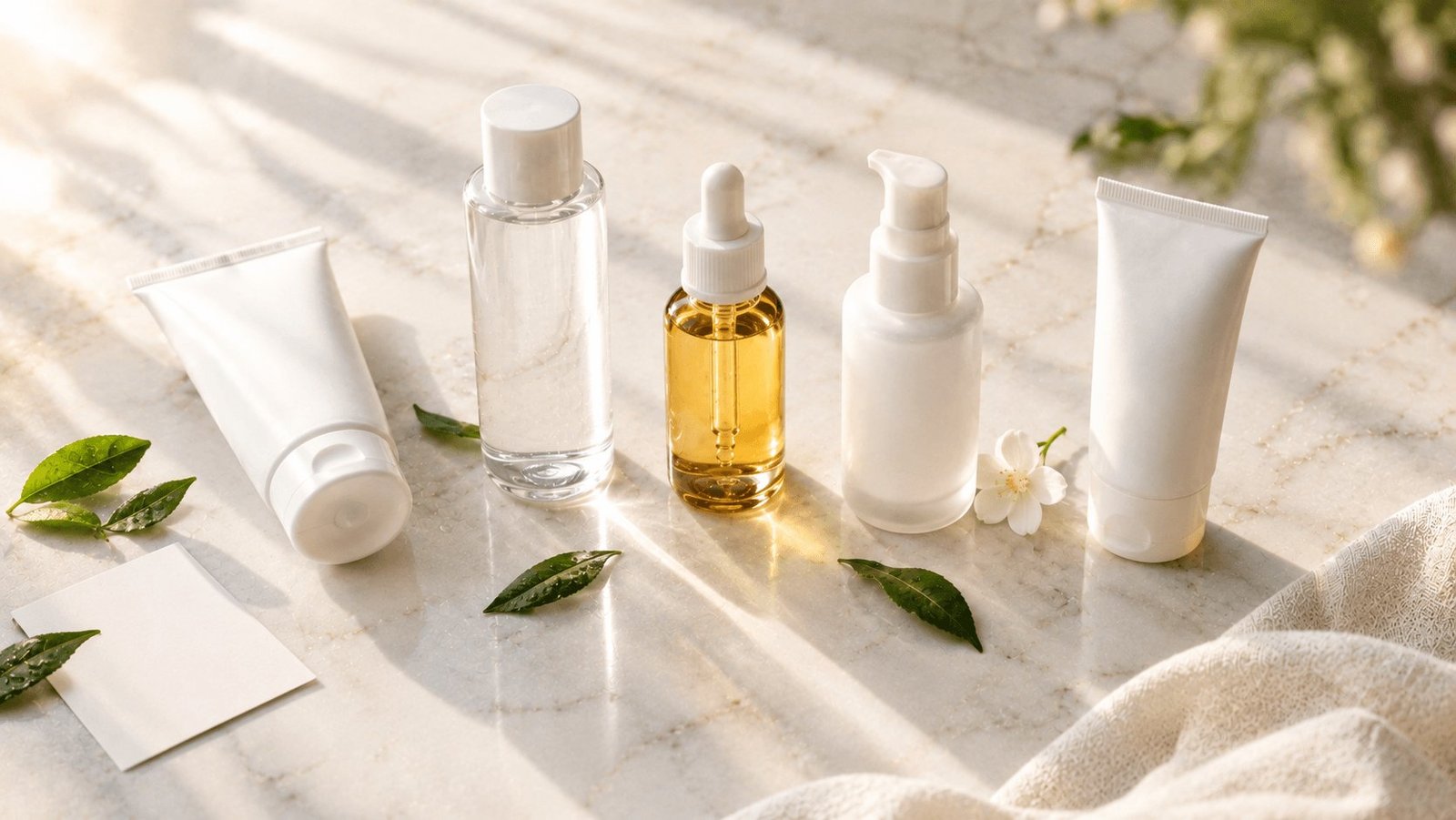
The most confusing thing anyone ever said to me about skincare was “just follow the ten steps.”
I was standing in a K-beauty store for the first time, genuinely overwhelmed by shelves that went from floor to ceiling. A well-meaning friend had handed me a printed list. Cleansing oil, water cleanser, exfoliator, toner, essence, ampoule, serum, sheet mask, eye cream, moisturizer, SPF. That’s eleven things. I stood there reading it, wondering which of these was technically optional and which would cause visible consequences if I skipped it.
I bought three products and went home.
Those three products — a gentle cleanser, a moisturizer, and a sunscreen — were the right starting point. Not because they were all I needed forever, but because starting simple and building gradually is the approach that actually works for beginners. The full Korean skincare routine isn’t ten mandatory steps you need to start all at once. It’s a system you build over months, starting from a foundation that works, and adding products deliberately as you understand what each one does.
In 2026, Korean skincare has become simpler, smarter, and more beginner-friendly. Instead of using too many products, the focus has shifted toward healthy-looking skin, barrier repair, and long-term skin health. You do not need expensive products or a complicated routine to get started.
This guide is what I wish I’d had in that store. Everything you need to start Korean skincare in 2026 — explained honestly, in the right order, without the overwhelm.
What Korean Skincare Actually Is — Before Anything Else
Korean skincare starts from a different premise than Western skincare: if the barrier is healthy, hydration is maintained, and UV protection is consistent, problems are less likely to develop in the first place. This shifts the focus toward gentler cleansing, layered hydration, and daily SPF. The actives — retinol, vitamin C, exfoliating acids — come later and are applied on top of an already well-maintained base.
This is the key distinction that makes Korean skincare different — and that most beginner guides skip over entirely.
Western skincare treats problems. Korean skincare prevents them. Western routines start with actives and work backward to support. Korean routines start with support and add actives once the foundation is stable.
Instead of relying on one heavy moisturizer, a Korean skincare routine layers multiple lightweight hydrating products. A watery toner, a concentrated essence, a targeted serum, and a sealing cream each add moisture in a different form.
The layering approach works because multiple lightweight layers build hydration more effectively than one heavy product. Each layer has a function, and each builds on what came before it.
Understanding this philosophy before you buy anything changes which products you prioritize and why.
The 2026 Shift — What’s Changed for Beginners
In 2026, we have moved past the 10-step glass skin trend toward Skip-care — a minimalist approach focused on high-performance ingredients that repair the skin barrier rather than just making it look shiny. Another major trend is Skin Longevity, which focuses on maintaining healthy skin for years instead of chasing quick results.
The ten-step Korean skincare routine became famous because it worked — but it was misunderstood as something you needed to do all at once from day one. 2026 is the year of the pared-down Korean skincare routine. Many have trimmed it down to a three to five-step protocol with curated products that target specific skin needs. Don’t mistake this minimalist approach for a less effective one.
The biggest trend in 2026 is multi-functional products that combine multiple benefits in one step.
For beginners specifically this is good news — you don’t need to buy fifteen products to start Korean skincare in 2026. You need four. The rest is optional enhancement once those four are established and working.
The Four-Step Foundation — Start Here
The best Korean skin care routine for beginners is a simple one. Focus on a 3-step sequence featuring a gentle cleanser, moisturizer, and daily SPF50+ PA++++. If you feel like adding a fourth step, a hydrating serum layers easily into a minimalist regimen.
I recommend four rather than three — the toner step makes everything else work better and costs very little to add. But if you want to start with three and add the toner in two weeks, that’s a legitimate beginning.
Step 1 — Gentle Low pH Cleanser
The oil cleanser dissolves makeup sunscreen and sebum. Double cleansing is the foundation of Korean skincare in the evening — oil cleanser first, then water-based cleanser.
In the morning — a single gentle water-based cleanser. In the evening — if you wore sunscreen (which you will, by Step 4) oil cleanse first, then the water cleanser.
What to look for: Low pH (around 5.0 to 5.5), no SLS, no harsh foaming agents, no fragrance if you’re unsure about sensitivity.
Best beginner option: COSRX Low pH Good Morning Gel Cleanser — $14. Works for every skin type, lasts two to three months, low pH that doesn’t strip your barrier.
This is covered in full in my guide on the best Korean cleansers on Amazon — every option there is a legitimate starting point.
Step 2 — Hydrating Toner
Korean toners are fundamentally different from Western toners. Korean toner: hydrating, pH-balancing, preps skin to absorb next steps. Western toner: often astringent, designed to remove residue and tighten pores. The Korean toner adds hydration, while the Western toner often removes it.
This distinction surprises most beginners from Western skincare backgrounds. Korean toners are not astringent. They’re not for removing makeup. They’re for restoring moisture balance after cleansing and preparing your skin to absorb what comes next.
After cleansing, pour toner into your hands or onto a cotton pad and gently pat onto your face and neck. Choose hydrating toners with ingredients like hyaluronic acid, green tea, or rose water to prep skin for the next steps.
Best beginner option: Anua Heartleaf 77% Soothing Toner — $19. Suitable for all skin types, calming, provides meaningful hydration without any ingredients that could cause issues.
I cover every toner worth considering in my guide on the best Korean toners on Amazon.
Step 3 — Serum or Essence
If you are exploring Korean skincare for beginners, the essence is one step that is genuinely worth investing in early. This is your targeted treatment layer. Serums address specific skin concerns: brightening, anti-aging, acne control, dark spots, or dehydration.
For a complete beginner — choose one serum based on your primary skin concern:
Oily or acne-prone skin: Beauty of Joseon Glow Serum (niacinamide + propolis) — $17 Dry or dehydrated skin: COSRX Advanced Snail 96 Mucin Essence — $19 Dark spots or dull skin: Anua Heartleaf 10% Niacinamide Serum — $19 Sensitive or reactive skin: Skin1004 Madagascar Centella Ampoule — $19 Anti-aging or mature skin: Beauty of Joseon Revive Serum (retinol + ginseng) — $17
One serum. Not three. The most common beginner mistake is buying multiple serums simultaneously and then not knowing which one caused a reaction or which one produced a result.
I cover the full serum category in my guide on the best Korean serums on Amazon — everything there is organized by skin concern to help you choose correctly.
Step 4 — Moisturizer
Hydrate skin and support your barrier with a fragrance-free moisturizer.
Your moisturizer provides the sealing layer that holds everything applied beneath it against your skin — it’s not optional even for oily skin types. I cover this at length in my Korean skincare mistakes guide — skipping moisturizer for oily skin is one of the most consistent errors that makes oiliness worse.
Oily or combination skin: COSRX Oil-Free Ultra Moisturizing Lotion — $18 (absorbs in sixty seconds, zero greasiness) Dry skin: Etude House SoonJung Panthenol Rescue Cream — $14 (gentle barrier repair) Sensitive skin: Etude House SoonJung 5-Panthenol Barrier Cream — $14 All skin types universal: Belif The True Cream Aqua Bomb — $38
My guide on the best Korean moisturizers on Amazon covers every option with honest skin-type-specific recommendations.
Step 5 — SPF 50+ PA++++ (Morning Only)
The actives come later and are applied on top of an already well-maintained base. But sunscreen — this is non-negotiable, every single day, even in winter.
This is the step that separates Korean skincare philosophy from every other approach — SPF is not optional, not seasonal, and not just for the beach. UV damage causes approximately 80% of visible facial aging. Every other product in your routine is undermined if you skip SPF daily.
Korean sunscreens are genuinely different from the Western formulas most beginners have been reluctant to wear daily — lighter, better absorbing, no white cast, no greasiness. This is where the “I’ll wear sunscreen daily” commitment actually becomes achievable.
Best beginner options:
- Beauty of Joseon Relief Sun SPF 50+ PA++++ — $17 (converts the most SPF-resistant beginners)
- PURITO Daily Go-To Sunscreen SPF 50+ PA++++ — $15 (fragrance-free, best for sensitive skin)
I cover both in my guide on the best Korean sunscreen for oily skin — the recommendations apply equally to all skin types.
Your Complete Beginner Routine — At a Glance
Morning (3 to 5 minutes)
- Gentle cleanser — 30 seconds
- Hydrating toner — pat in, 30 seconds
- Serum — apply, 60 seconds to absorb
- Moisturizer — 30 seconds
- SPF — apply, 90 seconds to absorb
Total time: Under 5 minutes
Evening (5 to 8 minutes)
- Oil cleanser on dry skin — 60 to 90 seconds
- Water cleanser — 30 seconds
- Hydrating toner — pat in, 30 seconds
- Serum — apply, 60 seconds
- Moisturizer — 30 seconds
Total time: Under 8 minutes
Building Your Routine — The 8-Week Schedule
For absolute beginners, start with just morning cleanser, toner, moisturizer, and sunscreen. Add one product at a time every two weeks. Your skin needs time to adjust, and this approach helps you identify what’s working.
This is the most important practical instruction in the entire guide. Do not buy everything at once and start using it all simultaneously. You will not know which product caused a reaction. You will not know which product produced a result.
Weeks 1 to 2: Cleanser, moisturizer, SPF. Morning and evening. Nothing else. Weeks 3 to 4: Add hydrating toner after cleansing. Weeks 5 to 6: Add your chosen serum after toner, Weeks 7 to 8: Add oil cleanser to evening routine before water cleansing.
By week eight you have a complete five to six step routine introduced deliberately, with full knowledge of what each product does on your specific skin.
Beginner Product Shopping List — Total Cost Under $90
| Product | Price | Lasts |
|---|---|---|
| COSRX Low pH Good Morning Cleanser | $14 | 2-3 months |
| Heimish All Clean Balm (oil cleanser) | $16 | 4-5 months |
| Anua Heartleaf 77% Toner | $19 | 2-3 months |
| COSRX Snail Mucin Essence (or skin-type choice) | $19 | 3-4 months |
| COSRX Oil-Free Moisturizer (or skin-type choice) | $18 | 2-3 months |
| Beauty of Joseon Relief Sun SPF 50+ | $17 | 2-3 months |
Total initial investment: $103 Monthly ongoing cost: approximately $25 to $35
All available on Amazon. I cover the complete budget strategy in my guide on Korean skincare on a budget — you can build this entire starter kit for under $90 if you start with cleanser, toner, moisturizer, and SPF before adding the serum and oil cleanser.
The Most Common Beginner Mistakes
Starting with too many products. The nine-product starting routine that breaks someone out in week two is untraceable because there are nine potential causes. Two products, established over two weeks, is the minimum responsible introduction period.
Buying based on what worked for someone else. The serum that cleared your friend’s skin addressed your friend’s specific concern. If your concern is different, their serum is doing nothing for you. I cover how to match products to skin types in detail across my skin-type-specific guides — Korean skincare for oily skin, Korean skincare for dry skin, Korean skincare for sensitive skin, and Korean skincare for combination skin.
Expecting results in a week. I still remember the first time I walked into a Korean skincare store and felt completely lost. Today, Korean skincare is part of my daily life. Consistency does the work. Hydration improves within days. Active ingredient results — niacinamide, vitamin C, retinol — require six to twelve weeks. Take a photo on day one.
Skipping SPF. Every guide says this. Skipping SPF once is fine. Skipping it most mornings means every brightening and anti-aging product you’re applying is fighting a losing battle against daily UV damage.
Using hot water. Hot water strips the acid mantle that regulates your skin’s barrier function. Lukewarm only, every time.
Skin Types — Quick Identification Guide
Before choosing products you need to know your skin type — the single most important variable in Korean skincare product selection.
Oily skin: Shiny by midday, enlarged pores, frequent breakouts Dry skin: Tight after cleansing, flaky patches, no shine Combination skin: Oily T-zone (forehead nose chin), normal or dry cheeks Sensitive skin: Reacts to products frequently, redness, stinging on application Normal skin: Comfortable throughout the day, minimal shine, rare breakouts
If you’re unsure — start with the gentlest available options across every step. Sensitivity and dryness symptoms often resolve once you switch from harsh to gentle products, so your initial self-assessment may change after four weeks of Korean skincare.
Understanding Ingredients — The Three You Need to Know First
You don’t need to understand every ingredient in every product to start. But three ingredient categories are worth knowing before you buy anything:
Niacinamide (Vitamin B3): Works for oily skin, dry skin, dark spots, pores, and barrier support simultaneously. The most universally beneficial ingredient in Korean skincare. Look for it in your serum.
Hyaluronic Acid: The most effective hydrating ingredient — holds water in the skin. Appears in toners, essences, serums, and moisturizers. Not an active — completely gentle and universally appropriate.
Centella Asiatica (Cica): Anti-inflammatory botanical. The most important ingredient for sensitive, reactive, or acne-prone skin. Calms redness, supports barrier healing.
I cover every Korean skincare ingredient in detail in my Korean skincare ingredients explained guide — that’s the reading that takes you from beginner to intermediate.
What Your Routine Should Feel Like
This sounds obvious but it genuinely helps to know: after each step your skin should feel comfortable. Not tight, not greasy, not stinging, not hot.
After cleansing — comfortable, slightly damp After toner — lightly hydrated After serum — smooth, slightly tacky until absorbed After moisturizer — comfortable, not heavy After SPF — very slightly present, absorbed within two minutes
If any step produces tightness, stinging, or visible redness — that product needs to be assessed before continuing. The systematic one-product-at-a-time introduction makes this identification straightforward.
FAQs From Real Korean Skincare Beginners
Do I need all ten steps to start? No. The best Korean skin care routine for beginners focuses on a 3-step sequence featuring a gentle cleanser, moisturizer, and daily SPF50+ PA++++. Start with three to four. The full routine is something you build toward over months, not something you start with.
Is Korean skincare expensive? Not at the entry level. The starter routine above costs under $90 total and lasts three to four months — roughly $22 to $30 per month. I cover the complete budget strategy in my Korean skincare on a budget guide.
Can I use Korean skincare with products I already own? Yes — if what you already own is gentle and working. The most important introduction is the philosophy, not replacing everything immediately. Switch your cleanser first if it’s harsh. Add a Korean SPF if you don’t have one you wear daily. Build from there.
How long before I see results? Healthy skin that looks and feels consistently comfortable is the first result — typically within two to four weeks. Visible texture and tone improvement from active ingredients takes six to twelve weeks.
Which Korean skincare brand should beginners start with? COSRX for budget-conscious beginners — their formulas are clean, effective, and consistently well-tolerated. Beauty of Joseon for beginners wanting traditional Korean ingredients at accessible prices. Both brands are covered extensively throughout this blog.
From Overwhelmed to Clear
That first visit to the K-beauty store felt like being handed a textbook in a language I didn’t speak. The printed list with eleven steps didn’t tell me which ones mattered or why. It didn’t tell me what order made sense or what skin type each product was for.
When I moved away and tried to simplify my routine, my skin paid the price. Dryness, dullness, and breakouts I hadn’t had since my teens. The philosophy behind Korean skincare is hydration first, everything else second. Layers of lightweight products work better than one heavy cream. And sunscreen — non-negotiable, every single day.
Start with the four products. Use them every day for four weeks. Then add one product from the guides on this blog that addresses your specific primary concern. Give that four more weeks.
Repeat until you have a routine that’s entirely yours — not copied from someone else’s skin, not built from a list of eleven things you bought on day one.
Korean skincare in 2026 is simpler and more effective than it’s ever been for beginners. The ten-step era is over. The era of doing a few things very well, consistently, is here.
You already know the first four steps. That’s enough to start tonight.